Document extraction pipeline that converts energy invoices into validated structured data.
Smart OCR
OCR + LLM pipeline that turns energy invoices into validated structured data, with schema validation built in.
Automate document extraction without leaving quality control to manual review alone.
PythonOpenAIOCRPydantic
Casefile Summary
Internal operations that need invoice data without repeating manual extraction and review work.
High reported accuracy was not enough unless downstream automation could trust the extracted schema.
To turn document handling into a repeatable backend workflow instead of a partially manual validation task.
Problem
Energy invoices arrived as semi-structured or unstructured documents in inconsistent formats, and the data inside them would otherwise have to be extracted manually. Raw OCR alone did not make the workflow safe enough for automation.
Architecture
The workflow keeps OCR, language extraction and schema validation as separate steps so failures stay visible and recoverable.
Document -> OCR layer -> LLM extraction -> Schema validation
    |             |              |                   |
    v             v              v                   v
 source       raw text      structured draft     trusted payload
Key Decisions
- Separate OCR failure from model failure.
- Validate extracted payloads with a typed schema before automation continues.
- Treat accuracy as useful only when the next system can trust the result.
System Diagram
flowchart LR
A["Uploaded PDF / Image"] --> B["OCR Engine"]
B --> C["Prompt Builder"]
C --> D["LLM Engine"]
D --> E["Pydantic Validation"]
E --> F["Trusted JSON Output"]
Operational Flow
Documents enter the pipeline
Source files arrive with inconsistent structure, formatting and text quality.
OCR and model layers run separately
OCR produces text, then the model turns that text into a structured candidate output.
Schema checks gate the workflow
Typed validation catches malformed or incomplete results before they become business data.
Trusted payloads move downstream
Only validated extractions continue into the systems that consume document data.
Repository Snippet
From the public API router. This is the actual shape of the extraction surface.
@router.post("/extract", response_model=ExtractionResponse)
async def extract_document(file: UploadFile = File(...)) -> ExtractionResponse:
    content = await file.read()
    if not content:
        raise HTTPException(status_code=400, detail="Uploaded file is empty")
    return pipeline.run(content=content, filename=file.filename)
Decision Record
Manual review reduced risk, but it also blocked scale and made extraction throughput expensive.
Combine OCR and LLM extraction with schema validation instead of trusting raw text extraction alone.
More validation logic to maintain, but much lower chance of silent bad data entering downstream workflows.
The pipeline stayed automation-first while keeping failures visible enough to correct.
Result
The system reached more than 98 percent accuracy on the target workflow while keeping the process automation-first.
Reported from internal monitoring on the target document set, not an externally audited benchmark.
Production Signals
- Structured validation reduced silent extraction failures.
- OCR and model output were treated as separate failure surfaces.
- Accuracy mattered only if downstream automation could trust the result.
- Document handling moved closer to a real backend workflow than a review-heavy manual step.
Public Repository Evidence
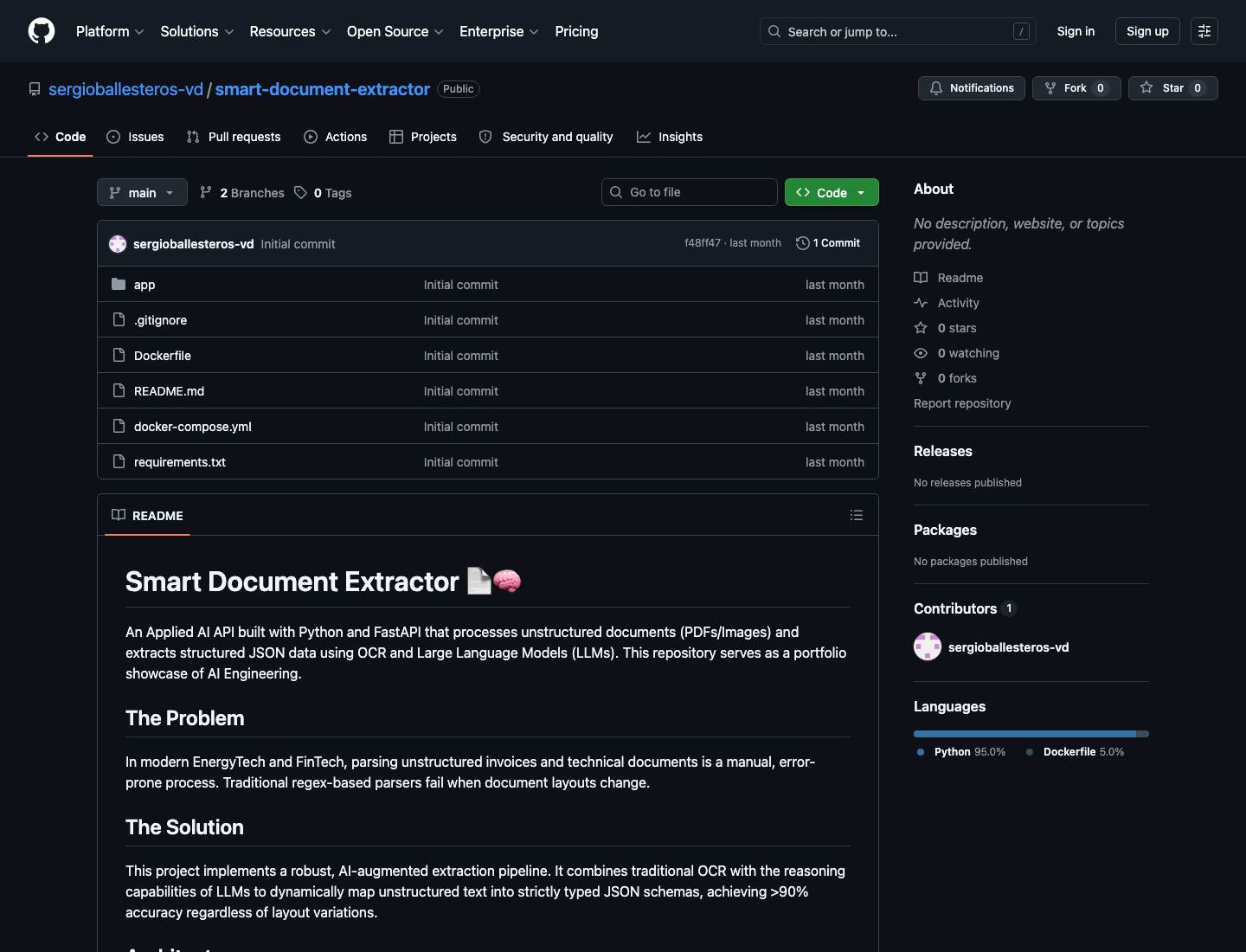
This workflow also exists as a public technical artifact: smart-document-extractor.
- Verified public stack: Python, FastAPI, Pydantic, Docker.
- Verified public endpoints include
GET /api/healthandPOST /api/extract. - The public README documents the same OCR -> LLM -> validation pipeline described here.
Operational Readout
The public repository is useful evidence because it shows the extraction flow as an actual API surface, not just as portfolio copy.
Captured Surface
What I Learned
- Accuracy numbers are meaningless until a downstream system can act on the output without a human checking it first.
- Separating OCR failures from model failures made debugging bad extractions much faster.
- A typed schema at the boundary caught more real problems than any amount of prompt tuning.